The Knowledge That Has No Field: Scott, Achebe, and the Limits of Legibility

Over the last two years, I built a materials management module for a biotech client’s laboratory information system. The module tracks lot numbers, expiry dates, storage conditions, supplier details, and certificates of analysis. Every field exists because a regulation, a quality standard, or an operational requirement requires it. The module is thorough. It passed validation. It is, by any reasonable measure, good software.
Three weeks after go-live, the system was rejected.
Not formally. There was no meeting, no documented decision, no change request. The warehouse just continued using paper.
The arguments were practical on the surface: no time to implement, no capacity for the transition, too much going on. But the paper workflow they were protecting is more time-intensive than the system that would replace it. Handwritten logs, manual cross-referencing, manual inventory administration, and constant paper transport between floors. The efficiency argument ran in the wrong direction, and everyone in the room knew it. What was being protected was not time.
What was being protected was illegibility. Paper cannot be queried, filtered, dashboarded, or used to generate a deviation report. A handwritten notebook preserves the space where personal and professional judgment operates without oversight — where an analyst can note “something felt off about this batch” without that note becoming an auditable deviation record that triggers a CAPA.
But it is not only professional discretion that the paper protects. It also protects the human texture of the laboratory — the things that happen among people who work closely together, day after day, under high pressure and with limited resources. The mistake that a colleague caught and quietly corrected before it became a deviation. The favor — covering a calibration check, swapping a shift, running a sample out of sequence for someone who was behind. The small negotiations and accommodations that keep a team functioning. Once these are in a system, they become legible. A colleague’s mistake under pressure is logged as an error with a name and a timestamp. A personal favor becomes an unauthorized process deviation. The informal relationship between two analysts who trust each other’s judgment becomes a pattern visible to anyone with reporting access. Paper lets the laboratory be a workplace. The system I built would make it a record.
The operators understood this — without using these words — more clearly than I did. They were not resisting technology. They were resisting the transformation of their working lives into auditable data. Their knowledge, their errors, their relationships, their daily acts of professional judgment and human accommodation would all become monitorable, directable, subject to the kind of administrative attention that does not distinguish between a genuine quality failure and a colleague helping another colleague on a difficult day. They preferred the paper because the paper kept their world in a format the institution could not read.
The system I built still sits unused. It passed every validation criterion. It satisfied every regulatory requirement. And the people it was designed to serve chose not to use it. There is a difference between a system that can be read and a system that deserves to be trusted — between a system that is legible and one that is legitimate. I didn’t have the vocabulary for that difference until I read James C. Scott.
Seeing Like a State is a book that made me increasingly uncomfortable as I read it — not because it was unfamiliar, but because it was describing, in the language of historical catastrophe, the thing I do every day at work. Scott writes about states, empires, Prussian forestry, Soviet collectivization, and the design of Brasília. But what he is actually writing about is the process of making complex realities visible to administrative power by simplifying them into structures that can be read, measured, audited, and governed. He has a word for this. He calls it legibility. And he argues — with three decades of evidence and a historian’s patience — that the drive toward legibility, when it forgets that it is a simplification, destroys the very knowledge it cannot capture.
Chinua Achebe’s Things Fall Apart is the book that tests this at the human scale. It is 200 pages long and covers a civilization’s destruction with a momentum and suddenness that leaves no room for annotation. The margins of my copy are nearly clean — Achebe writes with a directness that makes the pencil feel presumptuous. The novel builds a world so fully realized that its erasure, when it comes in the final pages, arrives as a physical shift in register: the reader is moved, mid-sentence, from inside Umuofia to outside it. What had been a society becomes nothing more than a paragraph in an administrator’s report. I closed the book and understood that Achebe had made me feel the mechanism he was describing — the moment when a complex reality is compressed into a format that can be filed.
The question for this essay is not whether governance frameworks are good or bad. They are necessary. I build them. The question is where their limits lie — and whether the fact that a system can be read is sufficient grounds for accepting it as the system that should govern.
The State’s Eye
Scott’s argument begins with trees.
In late eighteenth-century Prussia and Saxony, the state needed to know how much revenue its forests would produce. The existing forests — diverse, messy, filled with species of varying ages, uses, and growth patterns — were illegible to the fiscal bureaucrats above them. So the state invented scientific forestry: the Normalbaum, the normalized tree. Diverse forests were felled and replanted as monoculture rows — single species, evenly spaced, same age, harvestable on a predictable schedule.
For one generation, it worked. Yields increased, and revenue became predictable. The fiscal problem was solved. Then, in the second generation, the monoculture forests began to die. The Germans coined a word for it: Waldsterben — forest death. Without the biodiversity that had sustained the soil, repelled pests, and maintained the microecology for centuries, the simplified forest could not reproduce itself. The legibility that made the forest visible to the state destroyed the complexity that made it a forest.

Scott writes:
These state simplifications, the basic givens of modern statecraft, were, I began to realize, rather like abridged maps. They did not successfully represent the actual activity of the society they depicted, nor were they intended to; they represented only that slice of it that interested the official observer. They were, moreover, not just maps. Rather, they were maps that, when allied with state power, would enable much of the reality they depicted to be remade. Thus a state cadastral map created to designate taxable property-holders does not merely describe a system of land tenure; it creates such a system through its ability to give its categories the force of law.
The pattern holds beyond forestry. Local practices of measurement and landholding — diverse, intricate, adapted to purely local interests — “could not be assimilated into an administrative grid without being either transformed or reduced to a convenient, if partly fictional, shorthand.” And these shorthands, “backed by state power through records, courts, and ultimately coercion, these state fictions transformed the reality they presumed to observe, although never so thoroughly as to precisely fit the grid.”
The map replaced the territory. The administrative simplification, intended as a tool for understanding, became the reality it governed. And what it could not represent — the ecological relationships, the local knowledge of which species supported which, the practical understanding accumulated over generations — was not just overlooked. It was reclassified. What the framework could not capture became, in the framework’s terms, nothing. Knowledge that had no field in the administrative model ceased to count as knowledge at all.
I keep returning to that sentence in my mind. Ceased to count as knowledge at all. This is the mechanism that matters — not suppression or censorship, but something much quieter: the slow process by which a system’s categories define the boundaries of the real. If it has a field, it exists. If it doesn’t, it doesn’t — or maybe more dangerously: it shouldn’t. The technician’s Post-it note. The analyst’s instinct. The operator’s intuition for when a process is running right and when something is off that the instruments haven’t caught yet. These exist, and they matter. But the systems I build often have no place for them, and in the logic of administrative legibility, what has no place has no existence.
The pattern repeats across every domain Scott examines. Compulsory surnames imposed on populations that navigated identity through context. Standardized weights and measures are replacing local systems that encoded practical knowledge about soil quality and trade relationships. The grid-plan city replaces the organic neighborhood. Each intervention made the population more visible to administrative power. Each erased knowledge that had no place in the administrative vocabulary.
Scott’s four conditions for when these modes of legibility can turn into catastrophes are precise: the administrative ordering of nature and society; a high-modernist ideology that places supreme confidence in scientific and technical mastery; an authoritarian state willing to impose the vision; and a prostrate civil society that cannot resist. When all four combine — Soviet collectivization, Tanzanian ujamaa villagization, Brasília — the consequences can be catastrophic.
Scott is, however, careful to note that the first condition, the drive toward legibility, is not unique to authoritarian regimes. It is the operating logic of every modern state, every corporation, every governance framework. Simplification is not optional. What matters is whether the simplifier knows what is being lost, respects this loss, and gives it shelter within or next to the system.
The knowledge that gets lost has a name. Scott calls it mētis — a Greek term for the practical, embodied, contextual intelligence that cannot be codified in manuals or captured in databases. The experienced farmer who reads the soil by its color and smell. The sailor who feels the weather changing before the instruments register it. The laboratory analyst who knows that this particular HPLC column runs slightly hot on Mondays because the air conditioning cycles differently after the weekend.
Scott is careful to distinguish mētis from pre-scientific fumbling. It is, he argues, “not merely the now-superseded precursor of scientific knowledge. It is the mode of reasoning most appropriate to complex material and social tasks where the uncertainties are so daunting that we must trust our (experienced) intuition and feel our way.” It is not ignorance. It is not superstition. It is knowledge that operates below the threshold of formal representation — the kind of knowing that no administrative system is designed to capture. A Post-it note thanking the warehouse operator for expediting materials for an anxious technician running a process for the first time. That note is mētis. My materials management module is techne. Scott’s argument is that when techne operates without awareness of mētis, it doesn’t just fail to capture local knowledge. It actively destroys it — not through hostility, but through the structural confidence that what the framework sees is all there is to see.
Umuofia: The Illegible Society
Achebe’s Umuofia is a society that functions entirely through mētis. Nothing about its governance would be legible to a colonial district commissioner. Or, for that matter, to an ISO or GMP auditor.
Authority is distributed, contextual, and earned. There is no king, no president, no single point of decision — yet its internal logic is visible from the opening pages. The novel begins with Okonkwo’s fame, established through his wrestling victory over Amalinze the Cat, a man unbeaten for seven years. Wrestling in Umuofia is not entertainment. It is a governance mechanism: the public demonstration and adjudication of status through physical achievement, witnessed by the community, remembered without documents. Okonkwo has earned three of four titles — each title requiring progressively greater wealth, social capital, and demonstrated commitment to the community. The title system is an org chart written in yams and palm wine rather than in boxes and reporting lines. It is precise, it is consequential, and no colonial register can read it.

The egwugwu — masked figures who embody ancestral spirits — serve as judicial authority, resolving disputes through a process that is simultaneously legal, theatrical, and religious. The Week of Peace imposes a temporal governance structure: during its duration, no violence is permitted, and violators face consequences administered by the earth goddess’s priest. Age-grade systems distribute civic responsibility across generations. Every one of these structures is a rule, a convention, a governing mechanism — as binding as any regulation and more deeply embedded than any compliance framework. The difference is that they are carried in practice rather than in documentation.

None of this fits an org chart. But all of it works. The egwugwu court resolves disputes in a community where the judges know the disputants, their families, their histories, the specific texture of the grievance. The rulings carry weight — not because they are documented, but because they are accepted. This is governance that is legitimate without being legible: it functions through the consent of the governed rather than through the documentation of the governing.
The colonial administration that arrives in the novel’s final third cannot read any of it. They see no written constitution, no court of record, no chain of command. Achebe renders the moment with brutal economy: the District Commissioner, faced with Umuofia’s complexity, sees only absence. No government. No law. No religion. Just ignorant customs to be replaced with proper institutions. A society’s entire governance architecture — refined over centuries, adapted to its ecology, social structures, and spiritual life — becomes knowledge that has no field in the colonial register.
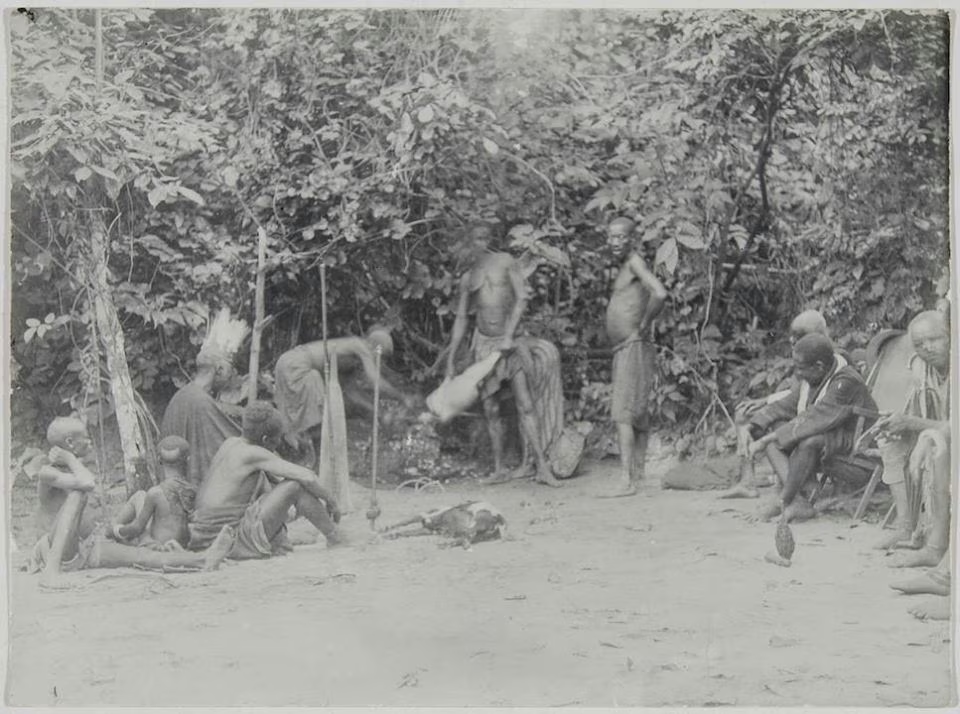
The missionaries begin the translation. They render the Bible into Igbo, creating a written text that standardizes what was oral, contextual, and polyphonic. The concept of chi — a word that carries meanings ranging from personal destiny to individual god to the animating principle of a life — becomes “God.” A philosophical vocabulary that took centuries to develop flattened into a single borrowed concept from a different civilization’s metaphysics.
The court system completes what the missionaries began. The egwugwu’s contextual justice is replaced by a court with appointed judges, written records, and codified procedures. The new system is legible. It produces documentation. It can be read by administrators in Lagos or London. What it is not, and what it cannot become through documentation alone, is legitimate. It has no relationship to the community’s understanding of justice, no continuity with the governance structures that preceded it. It requires continuous enforcement from above because it has earned no acceptance from below. This is Scott’s catastrophic simplification made institutional: a governance system that can be read perfectly and trusted by no one who is subject to it.
Achebe does not romanticize what the colonial system destroys. This matters. Umuofia’s governance includes practices that are cruel — the killing of twins, the treatment of osu, the violence embedded in masculine honor codes. The novel’s honesty lies in refusing both the colonial narrative (a primitive tribe civilized by European order) and the counter-narrative (a paradise destroyed by foreign invasion). The story of Okonkwo is a true story in the way that only fiction can be true: with all its grandeur and weakness. What Umuofia possesses in the novel is not perfection but coherence — a system adapted to its own complexity, functioning through knowledge that the incoming administrative order has no categories for, and therefore classifies as absence.
The destruction is not driven by malice but by incomprehension. The District Commissioner does not hate Umuofia. He cannot see it. His governance framework cannot represent what Umuofia knows, and in the logic of administrative legibility, what cannot be represented does not exist. The limit of his vision becomes the limit of his world.
The Man Who Could Not Bend
Okonkwo is the novel’s central tragedy, and he is also its most uncomfortable lesson for governance practitioners.
He is, by every measure his society recognizes, a success. He has earned three of four titles, commanded the largest yam harvest, and married three wives. He has overcome a father who was, by Umuofia’s standards, a failure — a debtor, a man without title. Okonkwo has built himself through will, discipline, and an absolute refusal to show weakness.
His rigidity is the point. Okonkwo cannot bend because bending reminds him of his father. When the Week of Peace requires restraint, he beats his wife anyway. When Ikemefuna — the boy entrusted to his care, whom he loves as a son — is condemned to death, Okonkwo strikes the killing blow himself because he is afraid of being thought weak. When the missionaries arrive, and his son Nwoye converts, Okonkwo’s response is not curiosity or grief but rage.
Achebe names the mechanism early:
Perhaps down in his heart Okonkwo was not a cruel man. But his whole life was dominated by fear, the fear of failure and of weakness. It was deeper and more intimate than the fear of evil and capricious gods and of magic, the fear of the forest, and of the forces of nature, malevolent, red in tooth and claw. Okonkwo’s fear was greater than these. It was not external but lay deep within himself. It was the fear of himself, lest he should be found to resemble his father. […] And so Okonkwo was ruled by one passion — to hate everything that his father Unoka had loved. One of those things was gentleness and another was idleness.
One of those things was gentleness. That single word names everything Okonkwo has amputated from himself — and everything that will be missing when the crisis arrives.
In Perrow’s terms — and the January essay’s framework applies here — Okonkwo’s household is a tightly coupled system. No slack between stimulus and response. No buffer between perceived threat and violent action. His fear of resembling his father is interactively complex with his society’s honor codes, and when the external shock of colonialism arrives, the combination produces what Perrow would call a system accident: the killing of the court messenger, the recognition that his community will not follow him into war, and the suicide that ends both Okonkwo and the novel.
But there is something else. Okonkwo’s own knowledge and expression of self has no field. He loves Ikemefuna but cannot say so — and the cost of that silence is the novel’s most devastating scene:
He heard Ikemefuna cry, “My father, they have killed me!” as he ran towards him. Dazed with fear, Okonkwo drew his machete and cut him down. He was afraid of being thought weak.
The child runs toward him for protection. Okonkwo does not act from duty or conviction but from fear — fear of being read as weak. He grieves for his daughter Ezinma’s illnesses and empathizes with his wife’s deep care for the girl, but only shows it in the middle of the night when none of the village is there to see.

He possesses tenderness, doubt, and affection. These emotions have no place in his self-constructed framework of masculine strength. In Okonkwo, Achebe shows legibility operating at the level of a single psyche: a man who has made himself readable as “strong” by erasing everything that complicates the reading. He is legible — his community can read him clearly. But the reading is not the man. His personal governance framework is as brittle as the colonial one. Both achieve clarity by suppressing what they cannot accommodate. Both purchase legibility at the cost of legitimacy — the internal legitimacy of acknowledging what is actually true.
The comparison with McCarthy’s father in The Road sharpens the diagnosis. Both are men protecting what they love in a world changing beyond their control. McCarthy’s father adapts moment to moment, learns from each trial, and adjusts his strategy to the reality he encounters. Resilient in Wildavsky’s sense. Okonkwo is anticipatory: he has one model of how the world should work, and when the world stops conforming to it, it and he break. The father in The Road carries the fire. Okonkwo is consumed by it.
A Reasonable Paragraph
The novel’s final sentences perform the very operation the essay has been describing. The perspective shifts — away from Okonkwo and Umuofia, into the mind of the District Commissioner. The reader, who has spent 200 pages inside a civilization, is suddenly outside it, looking down from an administrative altitude. The effect is not dramatic. It is bureaucratic. And it is devastating precisely because of that.
The District Commissioner, contemplating Okonkwo’s body hanging from a tree, reflects on the events. He is writing a book. He has seen much in his time administering the tribes of the lower Niger. Okonkwo’s story, he decides, will make interesting reading. Perhaps not a whole chapter. But “a reasonable paragraph.”
The title of his planned book: The Pacification of the Primitive Tribes of the Lower Niger.
This is legibility at its limit — and the limit is the point. An entire life — a man who wrestled his fate from nothing, who loved and destroyed and was destroyed, whose tragedy was inseparable from the civilization that produced him — compressed into a paragraph within an administrative narrative. The Commissioner is not evil. He is diligent. Curious in his way. Sincere in his belief that he is bringing order to chaos. He simply cannot see Okonkwo. His framework has no field for what Okonkwo represents. And so Okonkwo — everything he was, everything he carried, everything he failed to say — becomes a data point. Knowledge that has no field, entered as nothing.
The comparison with García Márquez is instructive here. In One Hundred Years of Solitude, Macondo — another village built from nothing, governed by local custom, eventually destroyed by external forces — is annihilated by wind. The destruction is mythic, prophetic, total: a hurricane erases the town while the manuscript that foretold its history crumbles in the reader’s hands. Márquez gives Macondo a death proportionate to its life. Achebe does something more cruel and more precise. Umuofia is not destroyed by wind or prophecy. It is destroyed by a paragraph. The District Commissioner’s planned book does not erase Umuofia through force or even through narrative. It erases Umuofia through filing. The administrative reduction is the destruction. Márquez’s Macondo at least gets an apocalypse. Achebe’s Umuofia gets a reasonable paragraph in a book that will gather dust in a colonial library, where no one will read it with care.
The novel we have just read — 200 pages of complexity, contradiction, beauty, and violence — is what the Commissioner’s paragraph erases. Achebe has said that the novel was written partly in response to Conrad’s Heart of Darkness and Joyce Cary’s Mister Johnson — novels in which African societies exist only as a backdrop for European self-examination. The District Commissioner’s book is the administrative equivalent: a narrative in which Umuofia exists only as raw material for the colonial governance project. The paragraph is legible. It is not legitimate. It can be read. It should not be accepted. And the difference between those two facts is the difference Achebe’s entire novel exists to insist upon.
For Practitioners
I recognize the District Commissioner. Not as colonial oppressor — the analogy would be obscene if taken literally — but as someone whose professional vocation is making complex systems legible. I build the dashboards. I design the data models. I define the status indicators. Every architectural decision I make determines what the system can see — and every decision leaves something at the margin that the system will never capture.
This recognition is not comfortable, and it should not be made comfortable. The temptation is to move quickly to solutions — to say “therefore we must design better systems” and list five principles for inclusive data architecture. But Scott’s argument is more unsettling than that. He is not saying that legibility fails because we haven’t tried hard enough. He is saying that legibility, as a mode of knowing, has inherent limits — and that those limits are invisible from inside the framework. The District Commissioner cannot see what he cannot see. That is the trap. It is also my trap, every time I open the data model and decide which fields to include.
But there is a second trap, subtler than the first, and the essay has been circling it without naming it directly. Legibility is not legitimacy. The words share a Latin ancestor — legere, to read, which gave us both “legible” (what can be read) and, through lex, “legitimate” (what is accepted as justified). But they diverge in meaning, and the divergence matters for practitioners.
A legible system can be read, audited, inspected, and governed from above. A legitimate system is accepted by the people subject to it as genuinely serving the purpose it claims to serve. These are not the same property. A validated QLIMS is legible — it produces the documentation that regulators require. Whether it is legitimate — whether the operators who use it daily accept it as genuinely serving quality rather than merely serving audit — is a question the validation protocol does not ask and cannot accommodate. The egwugwu court in Umuofia is legitimate and illegible: it works, it is accepted, it resolves disputes — and it cannot be documented in any format the colonial administration can read. The colonial court that replaces it is at once legible and illegitimate: it produces records, can be administered from Lagos, but has not earned the consent of the villagers subject to it.
The substitution is the danger. In regulated environments, legibility routinely presents itself as legitimacy. The system passes validation, and the organization treats the signature as evidence that the system works — rather than evidence that the system can produce documentation. The audit finds no major observations, and the organization treats the finding as evidence of quality — rather than evidence that the auditor’s framework was satisfied. The compliance report is filed, and the regulator treats the filing as evidence of security — rather than evidence that the report’s fields were completed. At each step, the capacity to be read is mistaken for the right to be trusted. This is self-referential compliance at its most structural.
The validation lifecycle is where this lands first in my own work. GAMP 5 takes complex, locally adapted laboratory workflows and imposes documentation structures that the regulator can read: user requirements, functional specifications, risk assessments, IQ/OQ/PQ protocols, and traceability matrices. The validation lifecycle makes the system visible to audit — that is its purpose, and it is necessary. But in every validation project I have worked on, there have been moments when the team knew something the documentation could not capture. A workaround that kept the process running. A sequence that mattered but wasn’t in the SOP. A dependency that existed in practice but was nowhere to be found in the requirements document. Scott would call this the mētis of the laboratory practice. The validation framework sees past it — not through any intent to suppress, but because its architecture has no place for knowledge that cannot be formalized. And the validation signature, once applied, confers a legitimacy the framework has not earned — a legitimacy that properly belongs to the operators whose knowledge the framework cannot hold. The framework depends on that knowledge to function. It has no way to acknowledge this.
ALCOA+ makes the tension between legibility and understanding explicit. Attributable, Legible, Contemporaneous, Original, Accurate — each principle makes data visible to audit. The plus signs add Completeness, Consistency, Enduring, and Available. Together, they define what counts as trustworthy data in regulated environments. But trustworthy data is not the same as understanding. A complete, consistent, enduring, available dataset can still be meaningless without the contextual knowledge that tells you why the readings shifted on Tuesday, what the analyst noticed about the reagent before the deviation was formally logged, how the process actually behaves versus how the protocol says it should behave. The data integrity framework captures the record. The knowledge that makes the record meaningful lives elsewhere — in the analyst’s judgment, in the operator’s experience, in the contextual awareness that no data model can formalize. The data is legible. The understanding that gives it meaning is not.
At the national scale, the stakes sharpen. NIS2 imposes incident reporting, risk assessment, and supply chain security documentation on vital sector operators. BIO2 does the same for Dutch government information systems. These frameworks make complex cyber-physical systems visible to regulatory oversight, which is necessary for national security. But Scott’s argument does not exempt necessary frameworks from his critique, and the legibility-legitimacy distinction applies with particular force. When a water board operator files an NIS2 incident report, the report captures what its fields allow. What the operator knows — the contextual judgment, the pattern recognition, the sense of “something was off before the alert triggered” — falls outside the report’s vocabulary. The report is legible to the regulator. Whether the reporting framework is legitimate — whether the operator accepts it as genuinely serving security rather than compliance — determines whether the next incident is reported fully, partially, or in the minimum terms required by the fields. The practitioner building NIS2 compliance systems should ask this question before designing the form, not after.
Even this journal’s concepts glossary is a legibility project. Each definition makes a concept navigable — available, findable, and standardized. But the concepts, in their original contexts, carry more nuance than any definition captures. Perrow’s “tight coupling” is embedded in 300 pages of case analysis. Scott’s mētis emerges from a book-length argument about state power and local knowledge. The glossary entry is a paragraph. Useful. Necessarily incomplete. A reasonable paragraph.
Scott does not argue against legibility. He argues against legibility that has forgotten it is a simplification — legibility that has lost sight of its own limits, and that has begun to treat the capacity to be read as justification for being accepted. The dangerous practitioner is not the one who builds frameworks. It is the one who mistakes the framework for the reality it was built to serve — who allows legibility to substitute for legitimacy, auditability for understanding, the map for the territory. The Commissioner is dangerous not because he writes reports but because he believes his reports are comprehensive. The auditor is dangerous not because she checks compliance but because she believes compliance is safety. The architect is dangerous not because he designs data models but because he believes his data model captures everything that matters about the process it represents.
The corrective is not to abandon frameworks. It is to build into every framework an awareness of where the limits lie — and to resist the structural temptation to treat readability as trustworthiness. A validation protocol that asks “what operational knowledge exists that this document does not capture?” A risk assessment that includes a field for risks we cannot formalize. A platform architecture that preserves space for the mētis of the operator — and that earns the operator’s acceptance rather than merely passing the auditor’s inspection. This may sound paradoxical — creating a field for the knowledge that has no field, earning legitimacy for a legibility project. It is paradoxical. But the alternative is how monoculture forests die in the second generation, how Umuofia’s governance is classified as absence, and how Okonkwo becomes a reasonable paragraph.
The Fire, Revisited
Last month’s essay asked: What is safety for? McCarthy’s answer was the fire — the irreducible commitment that makes maintenance meaningful.
Scott and Achebe deepen the question. The fire is not just what we protect. It is also what we cannot see — or see but cannot make legible.
The mētis of Umuofia — the practical, contextual, embodied knowledge that made the society function — was invisible to the colonial administration and was therefore destroyed. The mētis of the laboratory — the tacit knowledge that keeps the process running between audits — is invisible to the governance framework and is therefore at risk. The risk is not violent destruction but quiet erasure: the slow process by which the system’s formal representation replaces the reality it was built to describe, until the operators themselves begin to mistake the map for the territory — until legibility, unchallenged, assumes the authority of legitimacy.
Okonkwo could not bend, and the District Commissioner could not see. Between them, they destroyed what neither could preserve alone. The practitioner who inherits both warnings must hold both capabilities simultaneously: the structural vision that makes governance possible, and the awareness of where that vision reaches its limits. To build systems that are legible and to earn the legitimacy that legibility alone cannot confer.
Achebe gives the novel’s epigraph to Yeats: “Things fall apart; the center cannot hold.” Scott’s work suggests that sometimes things fall apart because the center holds too tightly — because the drive to make reality legible squeezes out the adaptive complexity that keeps it alive. And sometimes things fall apart because legibility was accepted as enough — because the capacity to read the system was mistaken for the right to govern it.
The practitioner who builds governance systems inherits both warnings. The center must hold. And it must know what it cannot hold — the knowledge at the edges, the mētis in the margins, the things that matter most and have no field. The system must be legible. And it must earn, rather than assume, its legitimacy — from the operators who keep their Post-it notes, from the analysts who carry the knowledge the system cannot see, from the people on the other side of the framework whose acceptance is the only thing that makes it more than documentation.
Extended Reading & Watching
- Scott, James C. Seeing Like a State: How Certain Schemes to Improve the Human Condition Have Failed. Yale University Press, 1998.
- Achebe, Chinua. Things Fall Apart. William Heinemann, 1958.
- García Márquez, Gabriel. One Hundred Years of Solitude. Harper & Row, 1970. Another village founded, governed by local custom, and destroyed by external forces — but where Achebe’s Umuofia is erased by administrative filing, Márquez’s Macondo is annihilated by wind and prophecy. The contrast illuminates what is specific about Achebe’s method: legibility as a mode of destruction quieter and more total than apocalypse.
- Scott, James C. Two Cheers for Anarchism: Six Easy Pieces on Autonomy, Dignity, and Meaningful Work and Play. Princeton University Press, 2012. A shorter, more accessible version of the mētis argument, applied to everyday life. The chapter on the futility of rigid institutional rules is directly relevant to quality management practice.
- Cutler, John. “Legibility and Legitimacy.” The Beautiful Mess, April 2025. A concise treatment of the legibility-legitimacy distinction applied to AI-driven organizational design. Cutler names the rhetorical move that governance practitioners should recognize: the moment when legibility presents itself as legitimacy — when the capacity to be read is treated as justification for being accepted.
- Concerning Violence. Dir. Göran Olsson, 2014. Frantz Fanon’s The Wretched of the Earth read over archival footage of colonial Africa. The administrative violence Scott theorizes is made visible — not as metaphor but as historical record.
- Timbuktu. Dir. Abderrahmane Sissako, 2014. A functioning community governed by local custom, occupied by jihadists who impose a legibility regime they cannot themselves follow — banning music, football, even laughter, while smoking in secret and arguing about the World Cup. The invisible football scene, in which children mime a full match in silence because the game has been prohibited, is mētis persisting under administrative erasure. The occupiers can police the framework. They cannot earn its acceptance. Every structural parallel to Umuofia under colonial administration is precise.
- Graeber, David, and Wengrow, David. The Dawn of Everything: A New History of Humanity. Farrar, Straus and Giroux, 2021. Challenges the assumption that complex societies require hierarchical governance — presenting archaeological and anthropological evidence for societies that operated through distributed, contextual authority structures resembling Umuofia more than the colonial state.
- Dekker, Sidney. The Field Guide to Understanding ‘Human Error’. CRC Press, 2014. Dekker’s argument that “human error” is not a cause but a symptom mirrors Scott’s argument that local knowledge is not ignorance but intelligence that the system cannot read. The “old view” of human error is the governance equivalent of the District Commissioner’s paragraph.
- Embrace of the Serpent. Dir. Ciro Guerra, 2015. Two knowledge systems encountering each other on a river — the Western scientist who classifies and the Amazonian shaman who navigates through relationship. Neither is wrong. Neither can read the other. The film dramatises exactly what the essay argues: the limit of legibility is not a failure of effort but a structural incompatibility between ways of knowing. The black-and-white cinematography enacts the reduction: a world of colour rendered in a format that cannot hold it.