Technology, Industrial Mobilization, and Total War: Malaparte's Witness to Systemic Transformation
When entire industrial economies mobilize for war, the transformation is systemic. Factories become front lines. Supply chains become strategic assets. Technical proficiency becomes a survival skill. The boundary between civilian infrastructure and military capability dissolves, and with it, the organizational cultures that governed peacetime operations.
Curzio Malaparte’s The Volga Rises in Europe — his collection of dispatches from the Eastern Front during World War II — captures this transformation with unusual clarity. As a front-line correspondent embedded with German and Finnish forces, Malaparte witnessed not just combat but the wholesale conversion of industrial capacity into military force. His account offers something rare: a ground-level view of technological mobilization, written with the observational discipline of war reporting and the analytical depth of political philosophy.
Malaparte’s observations resonate beyond their historical context as he documents how technological systems reshape human behavior, how operational cultures adapt under existential pressure, and how the integration of machine and human creates new organizational forms that resist traditional war narratives.
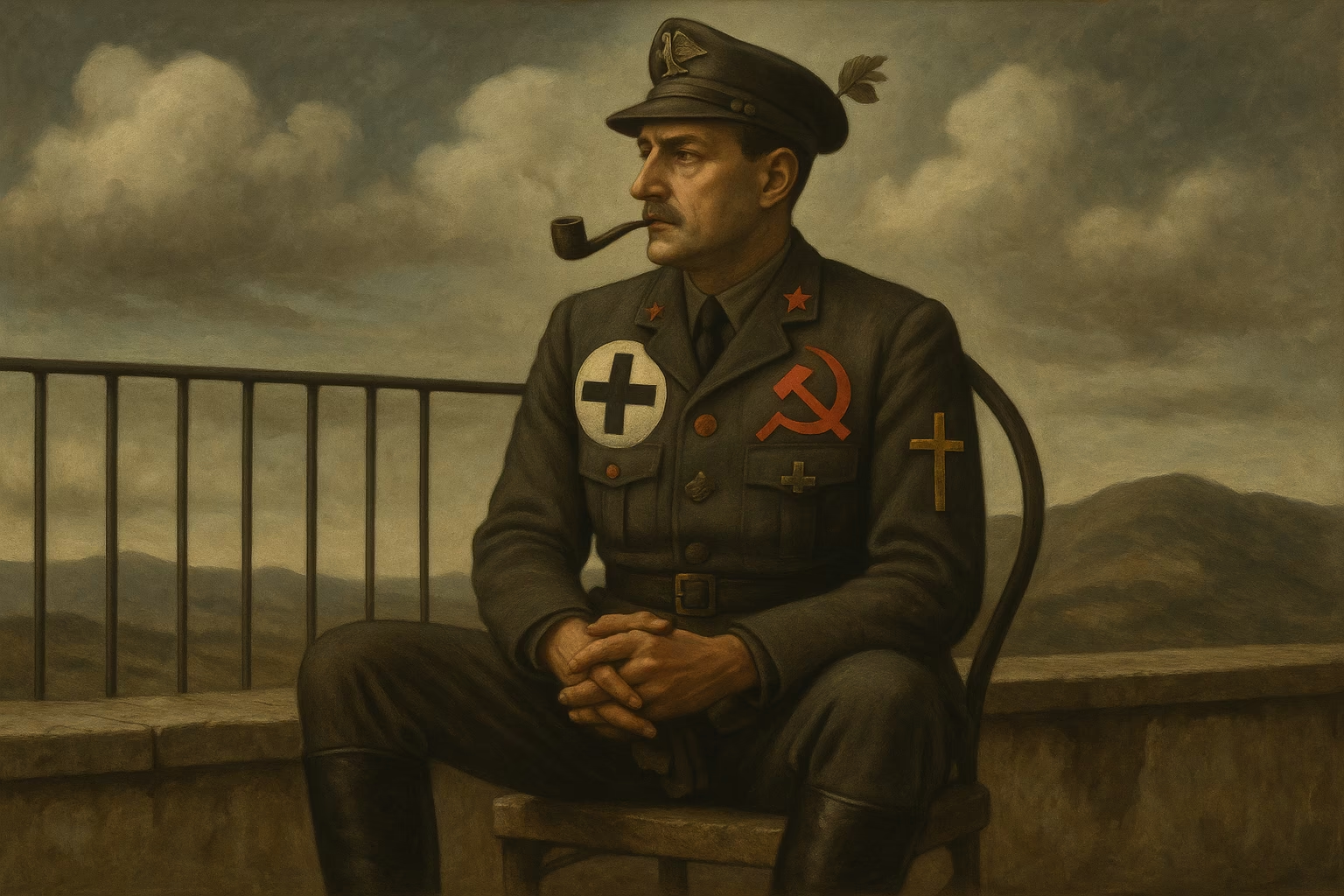
Born Kurt Erich Suckert in Prato, Tuscany, to a German father and an Italian mother, Malaparte took his pen name as a tongue-in-cheek play on Bonaparte. He is the epitome of the interbellum man of culture with shifting allegiances. In his thoughtful review of the novel The Skin, Andrew Stuttaford offers the most elegant, succinct description of Malaparte’s political wandering:
Malaparte was a fascist, and then he was not. He flirted with Communism, and then he did not. A protestant by baptism, an atheist by choice, he converted to Catholicism on his deathbed, but in his will left the house he had built on Capri, the most beautiful in the world, some said—his “Casa Come Me”—to the Chinese Communist Party.
Malaparte’s political slipperiness can make him an untrustworthy narrator to some critics. To me, the impossibility of placing Malaparte in a specific tradition — literary or political — makes him more trustworthy, and not less. We should not make the mistake of equating ideological consistency with strength of character and trustworthiness. Maintaining ideological consistency through the turbulence of modernity, WWI, the great upheavals of the Italian interbellum, and WWII would show rigidity, not the openness and intelligence one may expect of a politically engaged writer.
However, there is something very peculiar about Malaparte’s writing style. In his preface to The Volga Rises in Europe, Malaparte prides himself on the fact that notable contemporaries hail him as the most ‘objective’ reporter of the war. If his writing is ‘objective,’ it is not because its prose is sparse, succinct, and factual, as we may expect of journalistic writing. It is ‘objective’ rather, precisely because it is ‘hypersubjective’ — it captures the intensity of the war experience through hyperbole, by describing the border experience that could have only occurred then and there in excruciating detail. His great talent for finding representative and symbolic examples and describing them in lyrical detail makes Malaparte one of the greatest political authors I’ve read. The writing of Malaparte is politically colored and prone to exaggeration, straddling the line between fact and fiction, but it is so openly and by design. The reader is part of Malaparte’s political musing and meandering and is invited to see him test his political assumptions through his writing. It’s gonzo journalism meets political science. Hunter Thompson was probably a fan.
Malaparte’s hypothesis for The Volga Rises in Europe is laid out in the preface when he describes the theme that he meant to capture in the work’s originally intended title, War and the Strike Weapon, which was censored by the fascist authorities:
I chose it because I felt that the title War and the Strike Weapon brought out in full relief the social character of this war and the fundamental importance of the ‘proletarian ethic’ as a factor in the Soviet military power, to which all those social elements of the class struggle and of the technique of the proletarian revolution embraced by the word ‘strike’ made, and would continue to make, as significant a contribution as the weapons of war and the various aspects of the military art, such as discipline, technical training, tactical organization, etc.
There is a deductive quality to Malaparte’s approach here. There is a ‘proletarian ethic’ writ large that has taken form during the modern period on the European continent, and it’s spreading; it has a significant impact on the nature of modern warfare, and he means to find it. He is looking for the real and lived examples of what he thinks of as the great cultural achievement of the U.S.S.R., of what he calls ’the other Parthenon of Europe’:
Behind the Doric columns of the Pyatlyetki, the Five Year Plans, behind the rows of figures of the Gosplan, there stretches not Asia, but another Europe: the other Europe (in the sense in which America too is another Europe). The steel cupola of Marxism + Leninism + Stalinism (the gigantic dynamo of the U.S.S.R according to Lenin’s formula: Soviet + electrification = Bolshevism) is not the mausoleum of Genghis Khan but—in the very sense that bourgeois folk find so distasteful—The other Parthenon of Europe. ‘The Volga,’ says Pilnyak, ‘flows into the Caspian Sea.’ Yes, but it does not rise in Asia: it rises in Europe. It is a European river. The Thames, the Seine, the Potomac are its tributaries.
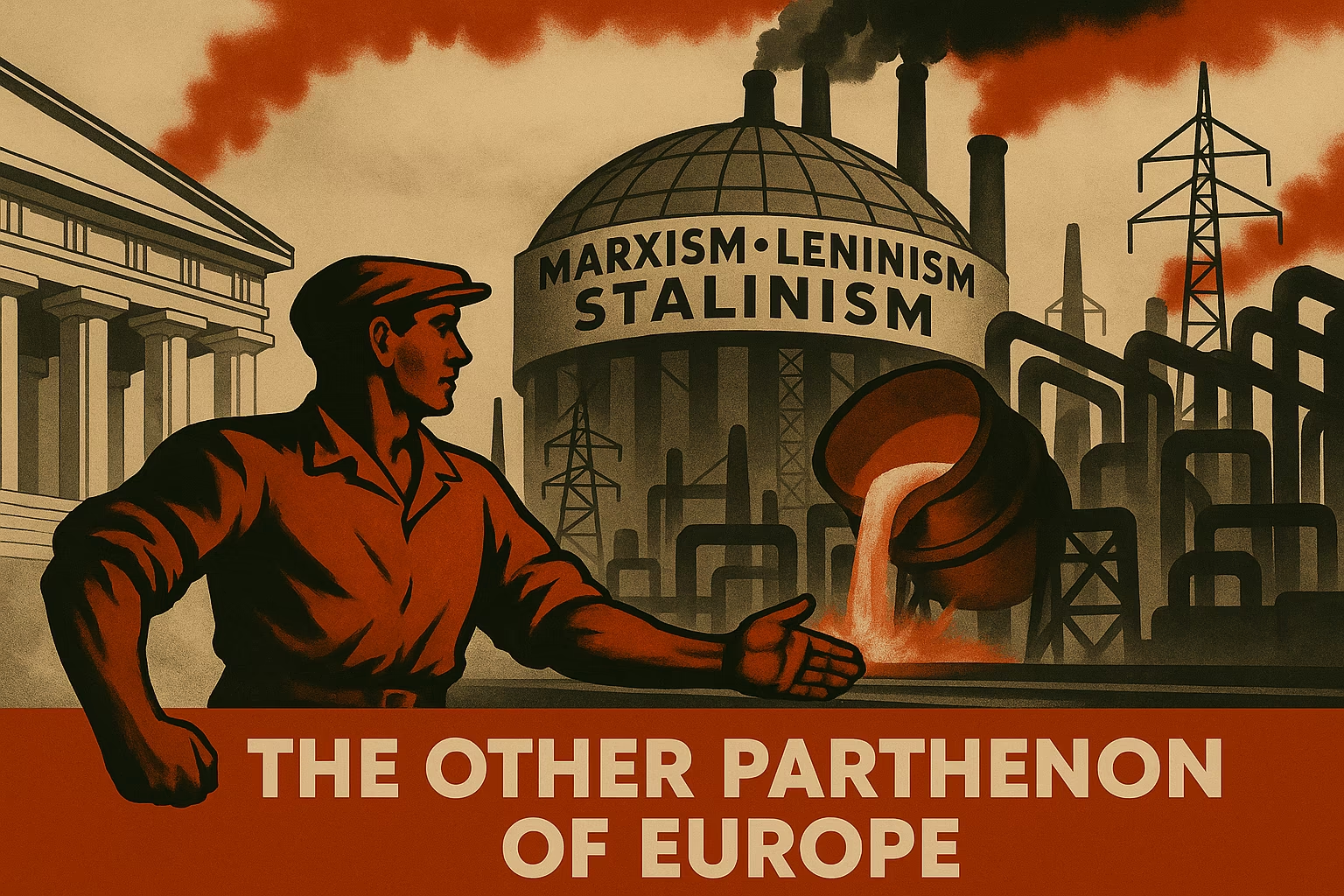
The Volga is the ‘proletarian ethic’, and it’s rising. One can imagine a stream of communist ideology flowing like a river over the map of Europe. The title is just subtle enough to dodge the fascist censors.
The first part of the book takes place in the summer of 1941. During this time, Malaparte was a frontline correspondent and followed the Germans as they advanced through the Ukraine to the Soviet Union. There is no real narrative to speak of here, other than fragmentary meetings with German soldiers, descriptions of the German advance, and more theoretical musings about the ‘proletarian’ and ‘industrial ethic’ that prevails in modern warfare.
The scenes of Ukraine are of a ‘countryside in agony, a torpid, impermanent, decaying countryside’. An insecure landscape, sitting in waiting for the storm that is the German army. It is this contrast between the silence of Europe’s granary and the noise, violence, and ruthless efficiency of the German Panzerwagens and motorized divisions thundering over its roads that makes up the central guiding image of this part of the book. Malaparte’s exploration of the impact of modern technology, coupled with an artisanal ‘proletarian ethic’ is here at its most explicit:
I watch them working; I note the way they use their hands, the way they hold things, the way they bend their heads over their implements. They are the same soldiers as I have seen ‘working’ in the streets of the Banato, outside Belgrade. They have the same impersonal, alert expressions, the same calm, deliberate, precise gestures, the same air of unsmiling equanimity. They reveal the same indifference to everything that is unconnected with their work. It occurs to me that perhaps the peculiarly technical character of this war is leaving its mark on the combatants. Rather than soldiers intent on fighting they look like artisans at work, like mechanics busying themselves about a complex, delicate machine. […] Their very gait, their very manner of speech, their very gestures are those of workmen, not of soldiers. The wounded have that tight-lipped, slightly angry air of workmen injured in an industrial accident. Their discipline has about it the same flexibility and informality as the discipline maintained by a gang of workmen. Their esprit de corps is an esprit d’équipe, a team spirit, and at the same time it is an esprit de métier. They are bound to their unit by the same bonds of loyalty and affection as unite a team of factory-hands to their machine, a team of electricians to their dynamo, a team of artisans to their lathe, to their boiler, to their rolling-mill. In the mechanized armies of today the officers are the technicians, the N.C.O.s are the foremen, the gangers.
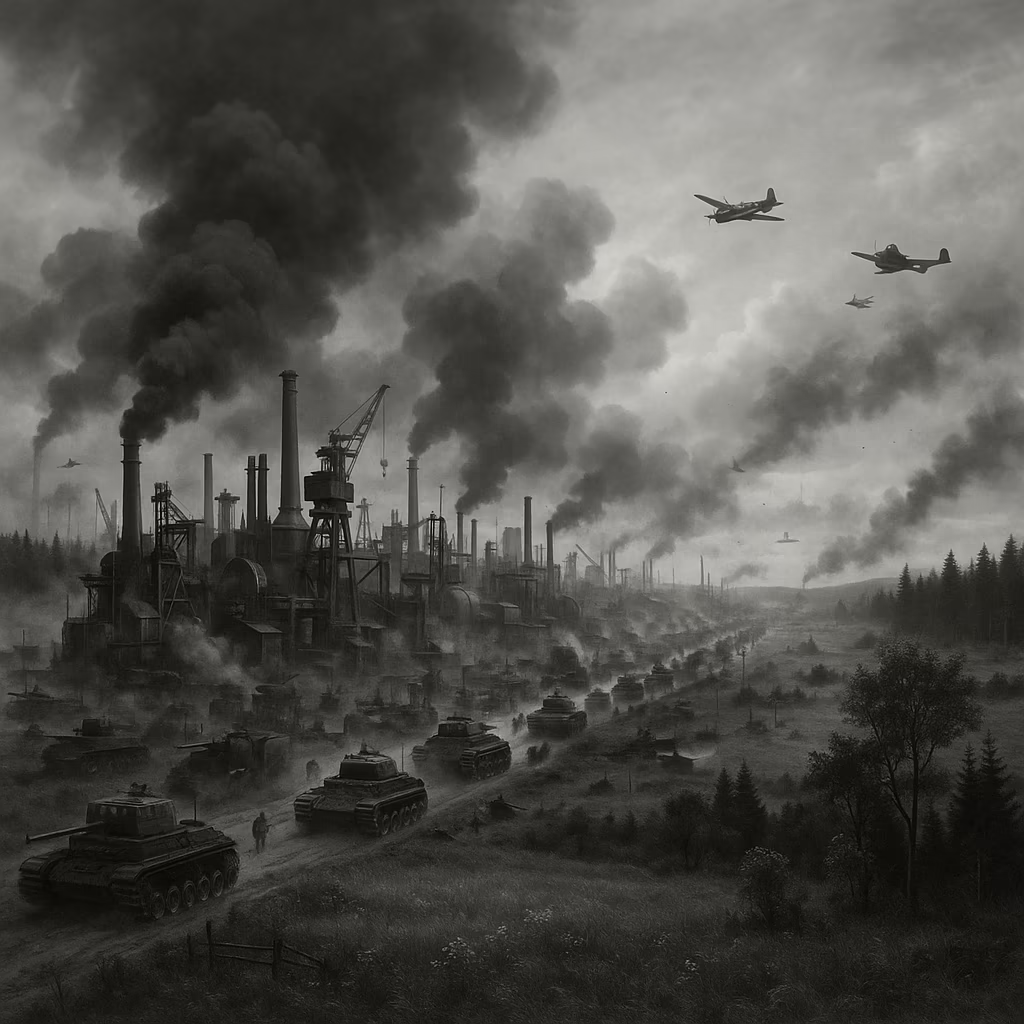
His descriptions of the German war machine leave no doubt — what we’re dealing with is the upending and mobilization of the whole of the German industrial complex in service of the war effort:
Below me, on both sides of the hill, down in the valley and again on the opposite slope, I could see, slowly advancing, not an army, but an immense traveling workshop, an enormous mobile foundry that stretched as far as the eye could reach in either direction. It was as if the thousands of chimneys, cranes, iron bridges and steel towers, the millions of cog-wheels, the hundreds and hundreds of blast-furnaces and rolling-mills of the whole of Westphalia, of the entire Ruhr, were advancing in a body over the vast expanse of corn-fields that is Bessarabia. It was as if an enormous Krupps Steelworks, a gigantic Essen, were preparing to launch an attack on the hills of Zaicani, of Shofroncani, of Bratosheni. Yes, that was it: I was looking not at an army but at a colossal steel-works, in which a multitude of workmen were setting about their various tasks with a streamlined efficiency which at first sight concealed the immensity of their effort. And what amazed me most of all was to see this gigantic mobile steelworks leaving behind it no trail of smoking ruins, no heaps of rubble, no blackened fields, but only peaceful villages and unscathed expanses of corn.
Operational Implications: When Industrial Capacity Becomes Infrastructure
Malaparte’s observation — that modern warfare transforms soldiers into technical operators and armies into mobile industrial complexes — illuminates a governance challenge that extends beyond military contexts: What happens when critical infrastructure operates under conditions where every component must function as both productive asset and strategic capability?
The Artisan-Operator Transformation of the Soldier
Malaparte’s description of German soldiers as “artisans at work” rather than combatants captures a shift in operational culture that appears whenever technical systems become complex enough to demand specialized knowledge. The soldiers he observes aren’t following rote procedures — they’re exercising judgment about complex equipment under uncertain conditions. The war-like machinery remains the same, and is indeed an extension of the operational technology environment in which artisans work. They have become expert environments that demand adaptive technical competence and situational judgment, not aimed at killing the enemy, but keeping the machinery of killing in working order. This is what Malaparte observes in German mechanics repairing equipment under fire.
Esprit de Métier and Operational Culture
Malaparte’s phrase “esprit de métier” — craft pride — highlights something that governance frameworks often overlook: the cultural bonds that develop when people share responsibility for maintaining complex technical systems. He notes that soldiers are “bound to their unit by the same bonds of loyalty and affection as unite a team of factory-hands to their machine.”
In critical infrastructure and validated environments, these bonds matter operationally. Malaparte observes that the German soldiers aren’t just following orders — they’re “bound to their unit by the same bonds of loyalty and affection as unite a team of factory-hands to their machine.” This isn’t sentiment; it’s the organizational glue that allows technical work to continue under degraded conditions.
When Malaparte describes soldiers maintaining equipment with “calm, deliberate, precise gestures” despite being under fire, he’s documenting how craft pride — esprit de corps — enables technical precision when formal command structures cannot micromanage every action. The NCOs function as “foremen” not because the hierarchy demands it, but because the technical work requires someone who knows the equipment intimately enough to guide others through novel failure states.
What Malaparte observes in the German technical units is precisely what resists documentation: the informal knowledge, mutual trust, and craft pride that enable effective response when conditions exceed what procedures anticipated. The soldiers he describes maintain technical discipline not because regulations require it, but because their identity as craftsmen — as people who take pride in keeping complex machinery operational — demands it.
When organizations treat operators as interchangeable resources executing standardized procedures, they eliminate the conditions that created what Malaparte observed: units where “officers are the technicians” and technical competence, not rank alone, determines authority during crisis response.
The Mobile Factory as Organizational Form Malaparte’s image of the German army as “an enormous mobile foundry” captures something structurally important: when industrial capacity must remain operational while moving through hostile territory, every organizational assumption about stability, supply chains, and operating conditions must be reconsidered.
Critical infrastructure faces analogous challenges when systems must remain operational during major changes, such as technology migrations, organizational restructuring, and regulatory transitions. The pharmaceutical CDMO executing a tech transfer while maintaining GMP compliance is also experiencing this shifting of rules of the machinery under the duress of operations realities, and so is the water utility upgrading SCADA systems without disrupting treatment operations, or the industrial facility implementing IT/OT network segmentation while maintaining production schedules.
In each case, the organization must function simultaneously as a stable operation and a transformation project — maintaining known-good states while reconfiguring fundamental architecture. Malaparte’s observation that the mobile factory leaves “only peaceful villages and unscathed expanses of corn” points to the challenge: major transformations must occur without disrupting the services the system provides or that is needed for their base survival as systems.
Technical Discipline Under Pressure
Malaparte repeatedly emphasizes the “calm, deliberate, precise gestures” of soldiers maintaining equipment under combat conditions. This isn’t rote execution — it’s technical discipline maintained when consequences of error are immediate and severe.
This quality is most evident in operational environments where technical precision is crucial, particularly when conditions are at their worst: the pharmaceutical technician executing validation protocols during a production crisis, the water treatment operator responding to contamination alarms, and the control room engineer managing an industrial process upset. In each case, the ability to maintain technical discipline when organizational pressure mounts determines whether the system degrades gracefully or fails catastrophically.
GxP regulations and ISO 9001 requirements emphasize the importance of following procedures, but they assume stable conditions where procedure execution is possible. Malaparte’s description of the soldiers reveals a distinct capability: the ability to exercise situational technical judgment and maintain craft standards despite an unstable operating environment.
The Coldness of the Finnish Winter
By September 1941, Malaparte was expelled by the fascist government at the Germans’ request and spent four months under house arrest in Italy. In March 1942, he was allowed to be dispatched again and accompanied Finnish troops during the siege of Leningrad, where he remained for almost a year. His experiences in the snow and silence on the Finnish front, with the great industrial city of Leningrad looming on the horizon, make up the book’s second part.
Whereas in the first part, I found myself skimming over some of the more expository passages, in the second part, Malaparte’s writing achieves the tone and brilliance I have come to expect from his work and adopts the style I became familiar with in my reading of The Skin and Kaputt. Some of the more imaginative experiences described by Malaparte here seem like finger exercises for his later works. One of the most striking images from Kaputt features a large group of horses frozen in the ice of Ladoga Lake near Leningrad. In The Volga, it’s not horses but Russian soldiers who are frozen in the ice:
Imprinted in the ice, stamped on the transparent crystal beneath the soles of my shoes, I saw a row of exquisitely beautiful human faces: a row of diaphanous masks, like Byzantine icons. They were looking at me, gazing at me. Their lips were thin and shrivelled, their hair was long, they had sharp noses and large, very brilliant eyes. (They were not human bodies, they were not corpses. If they had been I should have refrained from mentioning the incident.) That which was revealed to me in the sheet of ice was a row of marvellous images, full of a tender, moving pathos: as it were the delicate, living shadows of men who had been swallowed up in the mysterious waters of the lake.

In the passages that follow the image of the Russian soldiers frozen in ice, Malaparte gives what may be his best description of the aesthetic element he has sought to master throughout his work:
War and death sometimes partake of these exquisite mysteries, which are imbued with a sublimely lyrical quality. At certain times Mars is at pains to transform his most realistic images into things of beauty, as if there came a moment when even he was overwhelmed by the compassion which man owes to his like, which nature owes to man.
In his descriptions of the frost-bound army on the Finnish front, the discipline of journalism strikes a balance with an intense and lyrical aestheticization of the war’s excesses. The fragmentary descriptions of the silent, brooding Karelinian forests and the proud, equally brooding, silent Finnish soldiers in their isolated outposts are captivating. In the Finnish forests and hilltops, the rules of nature still reign supreme over the machine. The forest is portrayed as a living and breathing predator, in which only the young and most hardened Finnish soldiers, who were born in this organism, can move about with confidence. The scenes of them skiing through the forests, employing tactics of guerrilla warfare, and remaining unconcerned about their hardships, add to the idea that anything can happen when the Soviets cross the line into Finnish-held territory. One cannot help but feel sorry for the groups of godless, young Soviet troops who die all too readily and almost indifferently to protect their homeland.
Conclusion: Witnessing Systemic Transformation
Malaparte’s achievement in The Volga Rises in Europe is not journalistic objectivity in the conventional sense — it’s something more valuable. He captures the moment when industrial civilization reorganizes itself completely, when factories become front lines and technical competence becomes a survival skill. He does so with enough observational precision that the patterns he describes remain visible nearly a century later.
For system practitioners, Malaparte’s dispatches offer more than historical documentation. They reveal how organizational cultures transform under existential pressure, how technical discipline maintains itself when conditions make procedure-following impossible, and how the integration of human judgment and machine capability creates operational forms that resist traditional governance models.
The German soldiers he describes — maintaining esprit de métier while operating mobile industrial complexes through hostile territory — face challenges structurally similar to those in modern critical infrastructure: keeping complex technical systems operational during fundamental transformations, maintaining craft standards when operating conditions exceed design assumptions, and exercising technical judgment when formal procedures no longer apply.
Malaparte’s hypersubjective objectivity — his willingness to capture the intensity of the experience rather than flatten it into reportage — makes visible the human element that governance frameworks often abstract away. ISO 9001 can specify competence requirements. NIS2 can mandate incident response procedures. GxP can define validation protocols. But none can fully capture the esprit de métier, the craft pride and mutual trust, that makes complex systems governable when conditions exceed what documentation anticipated.
The Volga Rises in Europe stands as a testament to systemic transformation — proof that when industrial capacity is fully mobilized, the change is both cultural and technical. For those governing systems where transformation occurs while operations continue, Malaparte’s observations remain uncomfortably relevant: the mobile factory must move while remaining a factory, and sometimes technical discipline must hold when everything else gives way.