A prescient portrait of Putin's famous spin doctor's deeply cynical politics in Giuliano da Empoli's 'The Wizard of the Kremlin'
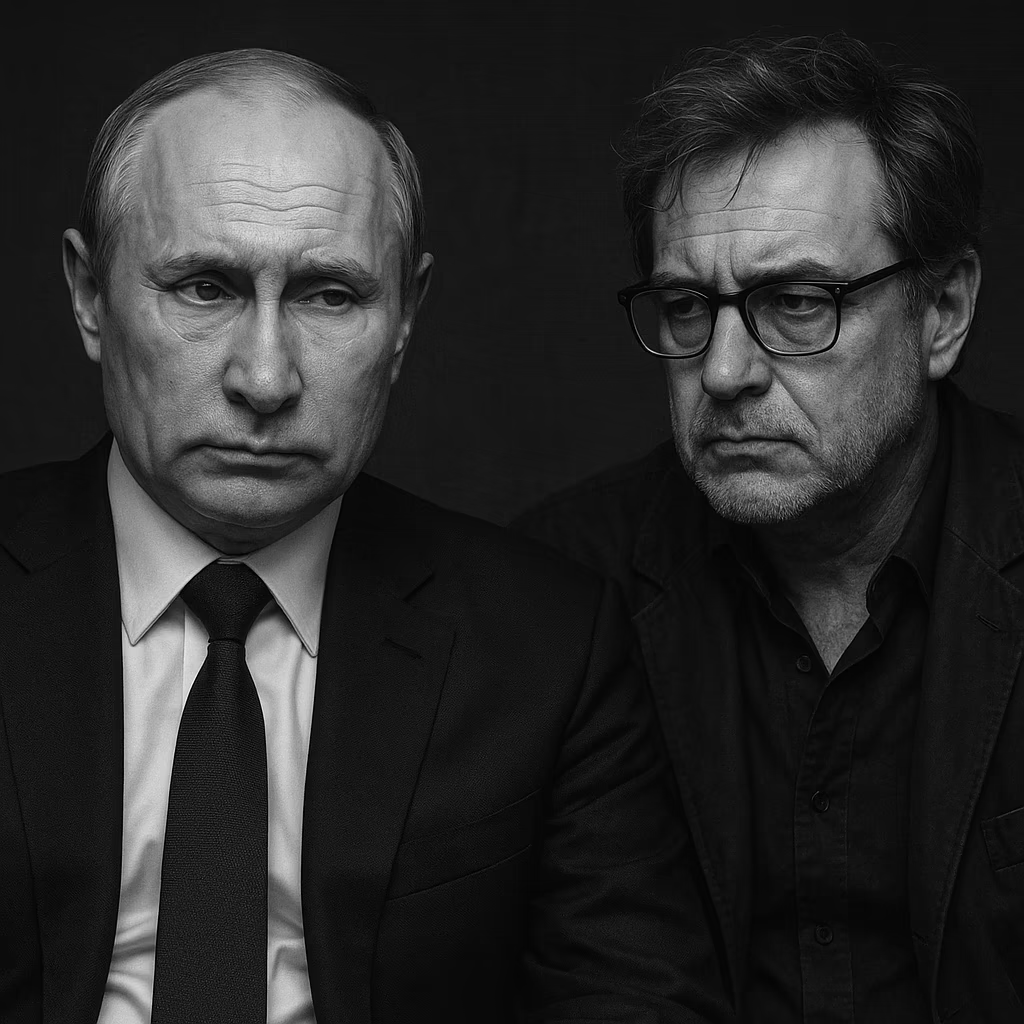
Giuliano da Empoli’s ‘Le mage du Kremlin’ (translated in Dutch as ‘De Kremlinfluisteraar’) was released in April, less than two months after Russia invaded Ukraine, which commenced in the last week of February. Although the manuscript was handed in in its final form as early as January 2021, it could not have been more prescient in its depiction of the political scheming of Putin ’le Tsar’ and his chief political advisor, Vadim Baranov (a fictionalised version of Vladislav Soerkov) to restore the vertical power axis in Russia after the ‘shock therapy’ of the 1990s.
Our main protagonist, Vadim Baranov, a deeply cynical theatre director of aristocratic descent turned soap opera writer, is approached by Boris Berezovsky, one of the Russian oligarchs who amassed his multibillion-dollar empire under the reign of Jeltsin. Berezovski recognises in Baranov a talent for staging absurd spectacles, which is invaluable. skill during the gangsterism and of the early post-Soviet period under Yeltsin. He asks Baranov to help with the political campaign of an unknown KGB bureaucrat who is projected to become the successor of Yeltsin, Vladimir Putin.
For Berezovski, Baranov is a potential Trojan Horse: a way to influence Putin and win him for him as he was able to do with Jeltsin. Beresovski could not be more misguided. However, it is immediately clear to Baranov that Putin is not a political actor that can be controlled. He is a political actor who doesn’t need to act because he doesn’t need to play a role. He is power-embodied. From that point onward, Baranov is a fellow traveller to Putin, who at points can advise, implement and supplement Putin’s vision to restore the office of the Russian president to its former Tsarist status: as the only meaningful focal point of authority in an otherwise deeply fragmented and corrupt political culture. If the President/Tsar holds still, Russia holds its breath in anticipation, fear and awe. Only when the President/Tsar moves does Russia move.
To implement their concept of ‘sovereign democracy’, Putin and Baranov follow the age-old adagium of divide and conquer. Arbitrary violence, political and judicial prosecution of friend and foe, the spread of misinformation at home and abroad, the appropriation of history to control the future, and the bribing of political opponents on both the right and the left - no political weapon is left unused to restore the ‘power vertical’ and to create and enforce the myth of Putin’s power. As if da Empoli is gifted with foresight, we see a Putin who is only interested in the enforcement and expansion of his power on the world stage and who sputters in anger about Western ambitions in Ukraine. Russia’s decline from superpower status is delayed through the solitary and forceful will of the Tsar.
‘Le Mage du Kremlin’ does not offer easy explanations or solutions. It is less interested in plot than in exposing the dynamics of a deeply cynical politics in which means and ends have become indiscriminate and where the idea of progress has long been discarded. In the Tsar’s world, nothing is real, and everything is staged — just as in Baranov’s absurdist theatre performances in the 1990s. The novel takes its motto from Alexandre Kojève, the Russian French philosopher: “Life is a comedy. One must play it seriously.” Both Baranov and Putin are masters at play, but is it serious play? One cannot but doubt. The cynical aristocrat and the one-time street fighter play the game - to explore what the highest echelons of power look like without seriously considering its effects on Russia’s future generations.
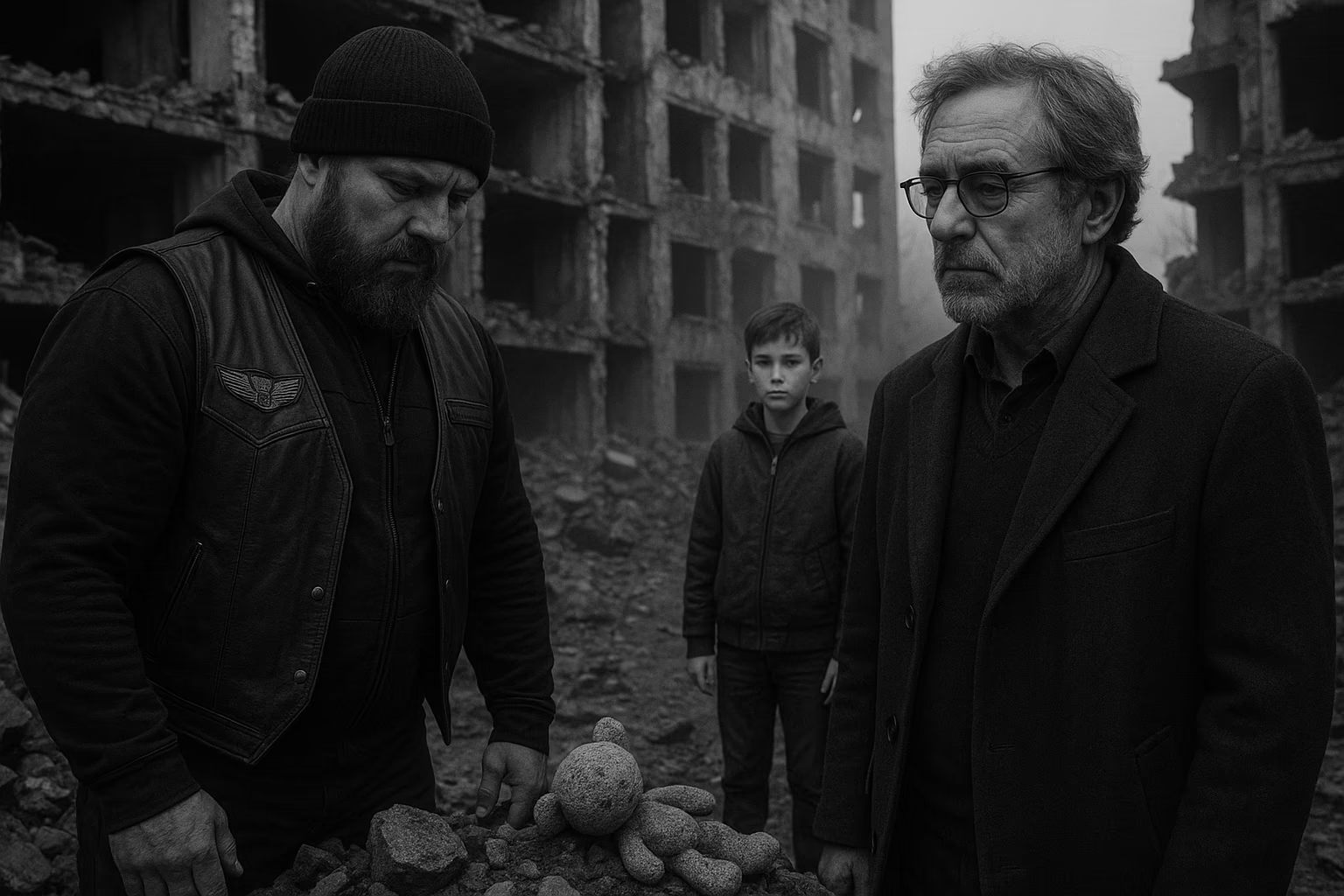
Baranov realises this in the end. In the two final scenes of the novel, he is confronted with the consequences of his politics. Through the eyes of the next generation of Russians, he finds empathy again: the children impacted by his engineering of chaos. As a response to Baranov’s orders to step up the chaos in Novorossiysk, the leader of the Night Wolves walks him to a bombed apartment building nearby to show him a blackened, decapitated doll among the ruins. His reaction is one of complete dissociation. In the final scene, his son walks in as he finishes telling the story of his political career to the novel’s narrator. His attention shifts from the largest circle imaginable, geopolitics, to his small direct circle. The only meaning he seems to have found in his wanderings is in a small circle: they are the creative pleasures of family life.